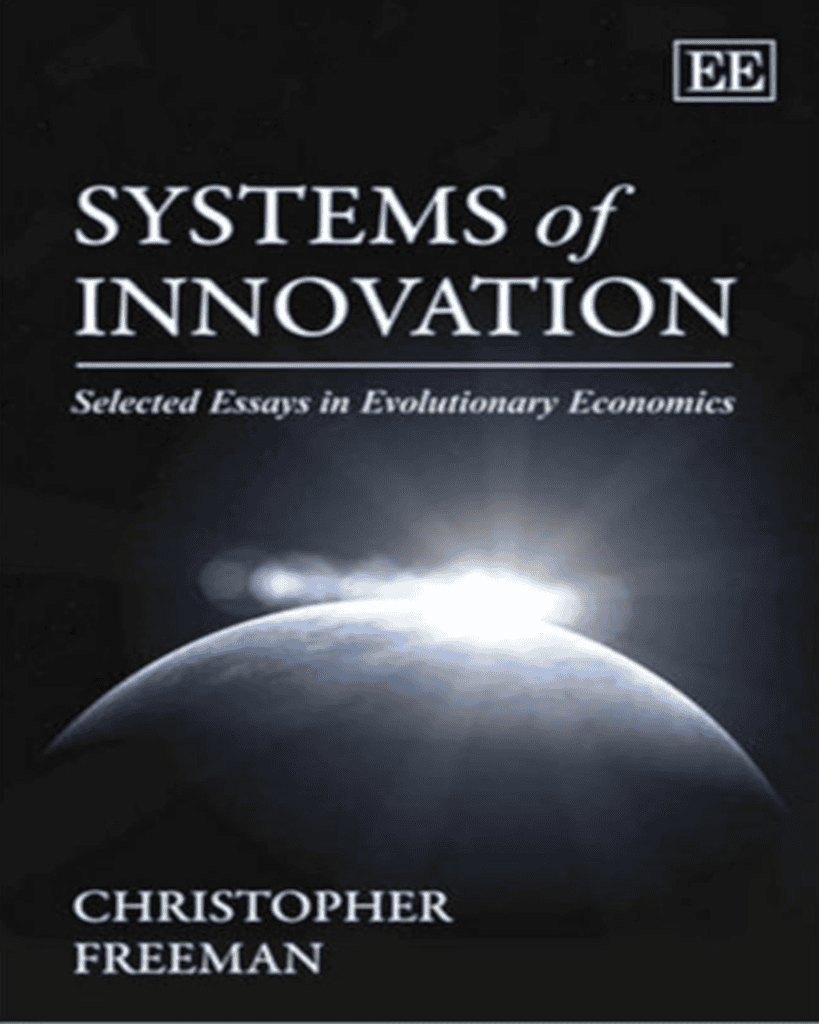
Systems of Innovation: Selected Essays in Evolutionary Economics brings together some of Christopher Freeman’s most influential contributions to the study of innovation, technological change and economic development. As one of the founders of innovation studies and a pioneer of the national innovation systems approach, Freeman offers a comprehensive perspective on how innovation drives long-term economic growth and structural transformation.
The essays trace the evolution of ideas that have shaped contemporary thinking on innovation. Moving beyond traditional economic models that treat technological progress as an external factor, Freeman argues that innovation is a cumulative, interactive and socially embedded process. Firms, universities, governments, research organisations and financial institutions all contribute to the creation, diffusion and application of knowledge, making innovation a systemic rather than isolated activity.
A central theme throughout the volume is the concept of innovation systems. Freeman explains how national institutions, policies and patterns of collaboration influence a country’s capacity to generate, absorb and apply new knowledge. He demonstrates that differences in innovation performance cannot be understood solely through investments in research and development, but must also consider education, industrial organisation, governance, learning processes and institutional capabilities.
The collection also explores the foundations of evolutionary economics, emphasising diversity, learning, experimentation and historical change as essential features of economic development. Technological innovation is presented as a dynamic process characterised by uncertainty, cumulative learning and continuous adaptation. Rather than moving towards equilibrium, economies evolve through the interaction of technological opportunities, entrepreneurial activity and institutional change.
Freeman further examines the relationship between technological revolutions and long waves of economic development, showing how major technological transformations reshape industries, labour markets and international competitiveness. His work highlights both the opportunities and challenges associated with technological change, including the need for effective public policies that support innovation while addressing social and economic transitions.
Although many of the essays were originally published over several decades, the ideas remain remarkably relevant. Contemporary debates on digital transformation, sustainability, industrial policy and inclusive development continue to draw upon concepts that Freeman helped establish. His work has also profoundly influenced research on national, regional and sectoral innovation systems, as well as policy frameworks adopted by governments and international organisations worldwide.
This volume serves both as an introduction to Freeman’s intellectual legacy and as a valuable reference for researchers, students and policymakers interested in innovation, economic development and evolutionary economics. By combining theoretical insight with historical analysis and policy reflection, the book demonstrates why innovation systems remain a cornerstone for understanding how economies learn, adapt and achieve sustainable development.