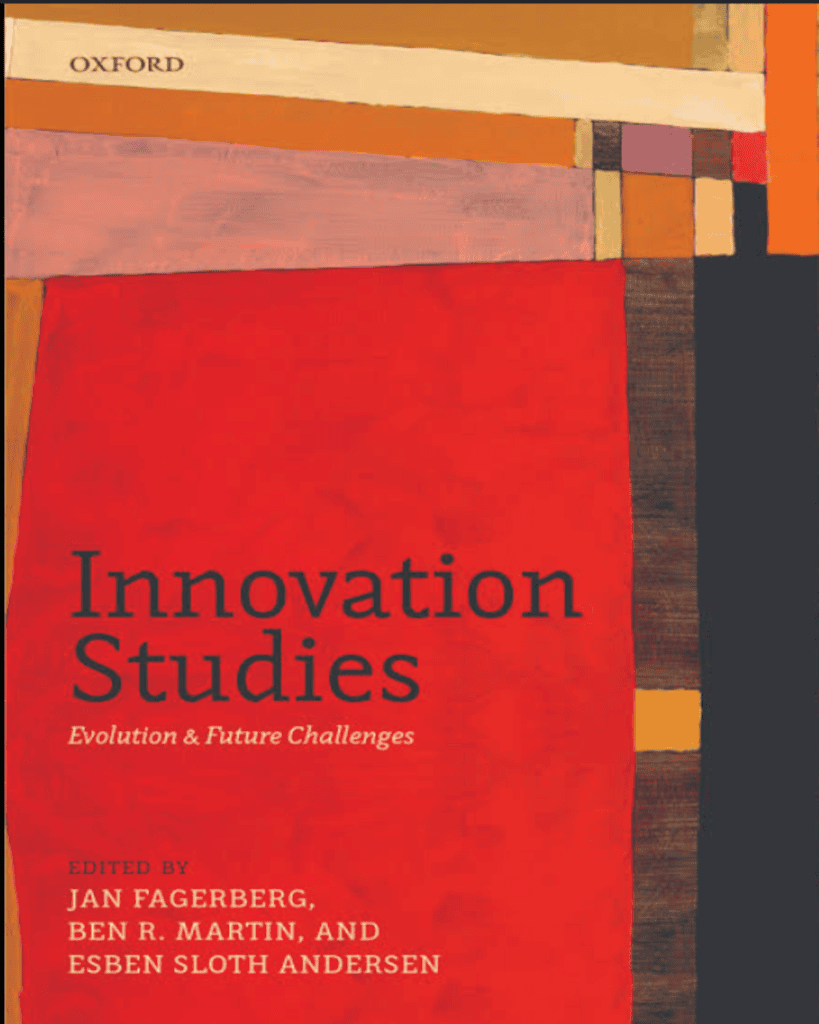
Innovation Studies: Evolution and Future Challenges offers a comprehensive assessment of the development of innovation studies as an interdisciplinary field and considers the directions it may take in the years ahead. Edited by Jan Fagerberg, Ben R. Martin and Esben Sloth Andersen, the volume brings together leading scholars to reflect on the theoretical foundations, empirical advances and policy contributions that have shaped research on innovation over the past decades.
The book traces the emergence of innovation studies from its origins in economics, management, sociology and science and technology studies into a vibrant field that examines how innovation contributes to economic growth, industrial transformation and social progress. Rather than treating innovation as a purely technological phenomenon, the contributors emphasise its systemic, interactive and evolutionary nature, highlighting the roles of learning, institutions, networks and public policy.
A central theme of the volume is the evolution of the field itself. The chapters review influential concepts such as national, regional and sectoral innovation systems, user-driven innovation, capability building, entrepreneurship and evolutionary economics. They examine how these ideas have transformed academic understanding of technological change while also influencing innovation policies around the world.
Beyond reviewing past achievements, the book identifies the major challenges facing innovation studies in the twenty-first century. Contributors discuss the implications of globalisation, digital technologies, sustainability transitions and increasing societal complexity for both research and policymaking. They argue that future innovation research must address not only economic competitiveness but also pressing global challenges such as climate change, inequality, health and inclusive development.
The volume also reflects on the growing importance of interdisciplinary collaboration. Innovation is presented as a multifaceted process that cannot be fully understood from a single disciplinary perspective. Instead, meaningful analysis requires insights from economics, political science, sociology, geography, management and science and technology studies. This interdisciplinary approach has become one of the defining characteristics of innovation studies and continues to shape its evolution.
Throughout the book, particular attention is given to the relationship between research and policy. The contributors demonstrate how innovation studies has informed the design of science, technology and innovation (STI) policies, industrial strategies and institutional reforms across both developed and developing countries. They also encourage greater engagement between researchers and policymakers to ensure that innovation contributes to sustainable, inclusive and socially beneficial development.
By combining historical reflection with forward-looking analysis, Innovation Studies: Evolution and Future Challenges provides an authoritative overview of one of the most dynamic areas of contemporary social science. It remains an essential resource for researchers, students and policymakers seeking to understand how innovation studies has evolved and how it can continue to respond to the complex development challenges of the future.