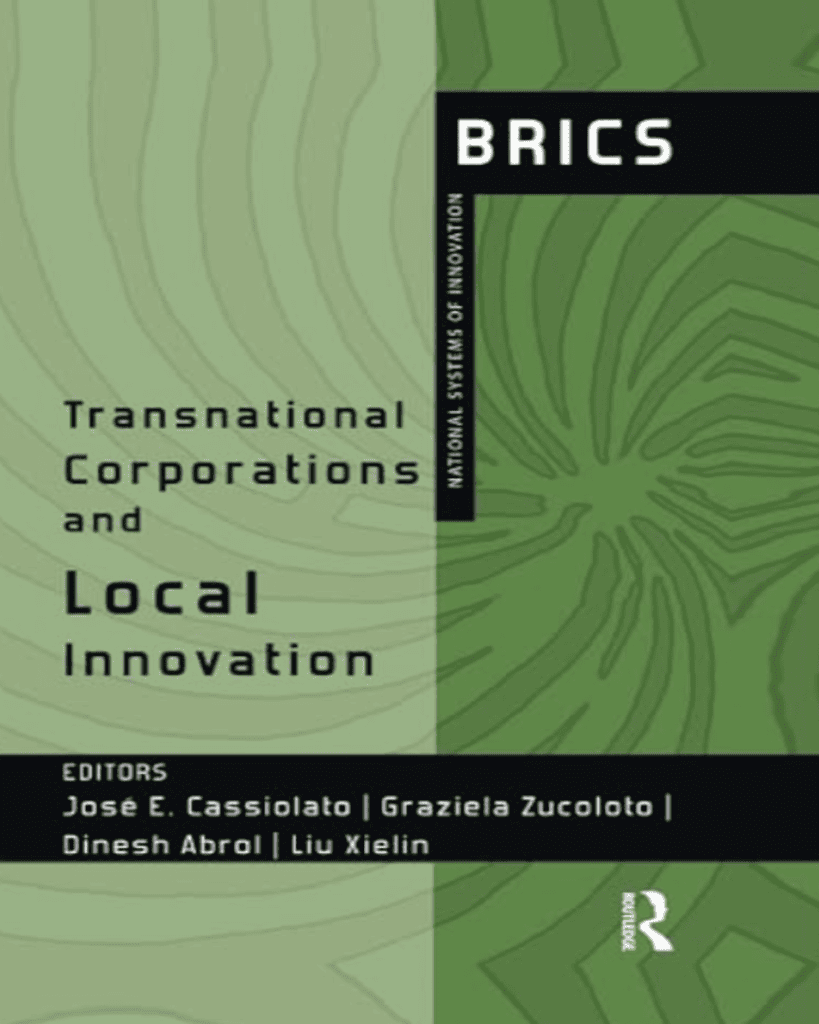
Transnational Corporations and Local Innovation: BRICS National Systems of Innovation examines the complex relationship between transnational corporations (TNCs) and the development of innovation capabilities in Brazil, Russia, India, China and South Africa. Edited by José Eduardo Cassiolato, Graziela Zucoloto, Dinesh Abrol and Xielin Liu, the book explores how multinational firms influence national innovation systems and assesses the conditions under which their presence contributes to—or limits—local technological development.
The volume challenges the assumption that foreign investment automatically generates innovation and economic upgrading. Instead, it argues that the developmental impact of transnational corporations depends on the strength of domestic institutions, the capabilities of local firms and research organisations, and the policies that shape interactions between global and national actors. Innovation is therefore presented as a systemic process in which local learning, institutional coordination and capability building remain essential.
Drawing on the National Systems of Innovation (NSI) framework, the contributors analyse how the BRICS countries have engaged with transnational corporations while pursuing their own strategies for industrial and technological development. Through comparative case studies, the book highlights the diversity of national experiences, showing that each country has developed distinct institutional arrangements and policy responses based on its historical trajectory, industrial structure and development priorities.
A central theme of the volume is the relationship between global production networks and domestic innovation. The chapters explore how transnational corporations participate in research and development, technology transfer, supplier relationships and knowledge networks. They also examine the extent to which these activities strengthen local capabilities or reinforce technological dependence. The analysis demonstrates that meaningful knowledge spillovers are not automatic but require active learning, absorptive capacity and supportive public policies.
The book pays particular attention to the role of governments in shaping innovation outcomes. Effective industrial, science, technology and innovation (STI) policies are shown to be crucial for encouraging collaboration between multinational enterprises, domestic firms, universities and public research organisations. By fostering stronger institutional linkages and investing in local capabilities, countries can maximise the developmental benefits of foreign investment while reducing structural vulnerabilities.
Beyond the BRICS context, the volume contributes to broader debates on globalisation, innovation and development. It highlights the need to balance international integration with domestic capability building and demonstrates that innovation-led development depends on both participation in global knowledge networks and the continuous strengthening of national innovation systems.
Combining theoretical perspectives with extensive empirical evidence, Transnational Corporations and Local Innovation provides valuable insights for researchers, policymakers and development practitioners interested in industrial policy, global value chains and innovation systems. Its comparative analysis offers important lessons for countries seeking to leverage foreign investment in support of inclusive, resilient and sustainable development.