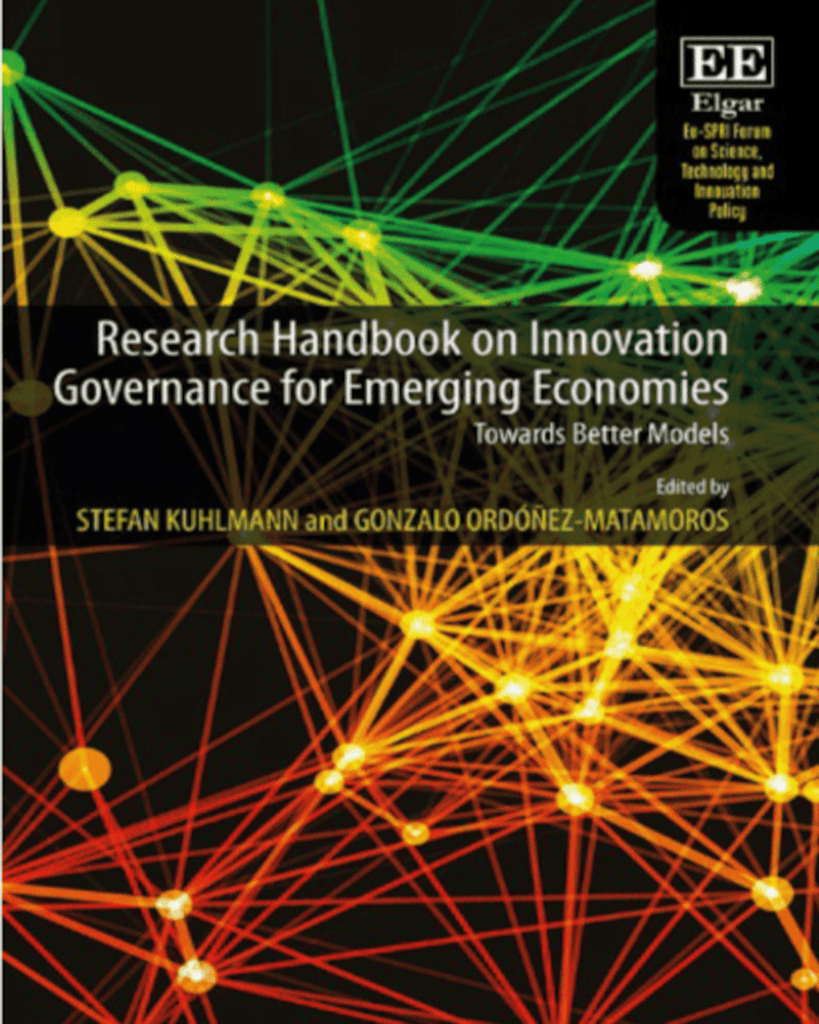
Research Handbook on Innovation Governance for Emerging Economies: Towards Better Models examines how innovation can be effectively governed in countries facing rapid economic, institutional and technological transformation. Edited by Stefan Kuhlmann and Gonzalo Ordóñez-Matamoros, the volume brings together leading scholars to explore how governance frameworks influence the design, implementation and evaluation of science, technology and innovation (STI) policies in emerging economies.
The book argues that innovation governance extends beyond the formulation of public policies. It encompasses the institutions, actors, networks and decision-making processes that shape how innovation systems evolve and respond to complex societal and economic challenges. As emerging economies seek to strengthen their technological capabilities and enhance competitiveness, effective governance becomes essential for coordinating diverse stakeholders and creating environments that encourage learning, experimentation and collaboration.
A central theme of the handbook is the recognition that governance models developed for advanced economies cannot simply be transferred to different institutional and developmental contexts. The contributors demonstrate that emerging economies require governance arrangements that reflect their own capabilities, policy priorities and socio-economic realities. Through comparative analyses and empirical case studies, the volume highlights the diversity of governance experiences across regions and emphasises the importance of context-sensitive approaches to innovation policy.
The chapters examine a broad range of topics, including institutional capacity, policy coordination, participatory governance, evaluation systems, public sector innovation, mission-oriented policies and the role of intermediary organisations in supporting innovation. Particular attention is given to how governments interact with universities, research institutes, businesses and civil society to address both market failures and broader systemic challenges.
The handbook also explores the growing complexity of innovation governance in an increasingly interconnected world. Globalisation, digital transformation and sustainability transitions require more adaptive and inclusive governance mechanisms capable of responding to uncertainty and fostering long-term learning. Rather than relying on hierarchical policy models, the contributors advocate collaborative forms of governance that encourage dialogue, experimentation and continuous institutional improvement.
Throughout the volume, innovation is presented as a collective and dynamic process that depends on strong institutions, effective leadership and meaningful engagement among multiple actors. The book therefore offers valuable insights into how governance arrangements can strengthen national innovation systems while contributing to economic development, social inclusion and environmental sustainability.
Combining conceptual advances with practical policy perspectives, Research Handbook on Innovation Governance for Emerging Economies has become an important reference for researchers, policymakers and practitioners interested in innovation governance and development. Its emphasis on institutional learning, policy adaptation and collaborative governance provides a valuable framework for understanding how emerging economies can design innovation systems that are resilient, inclusive and capable of addressing future development challenges.