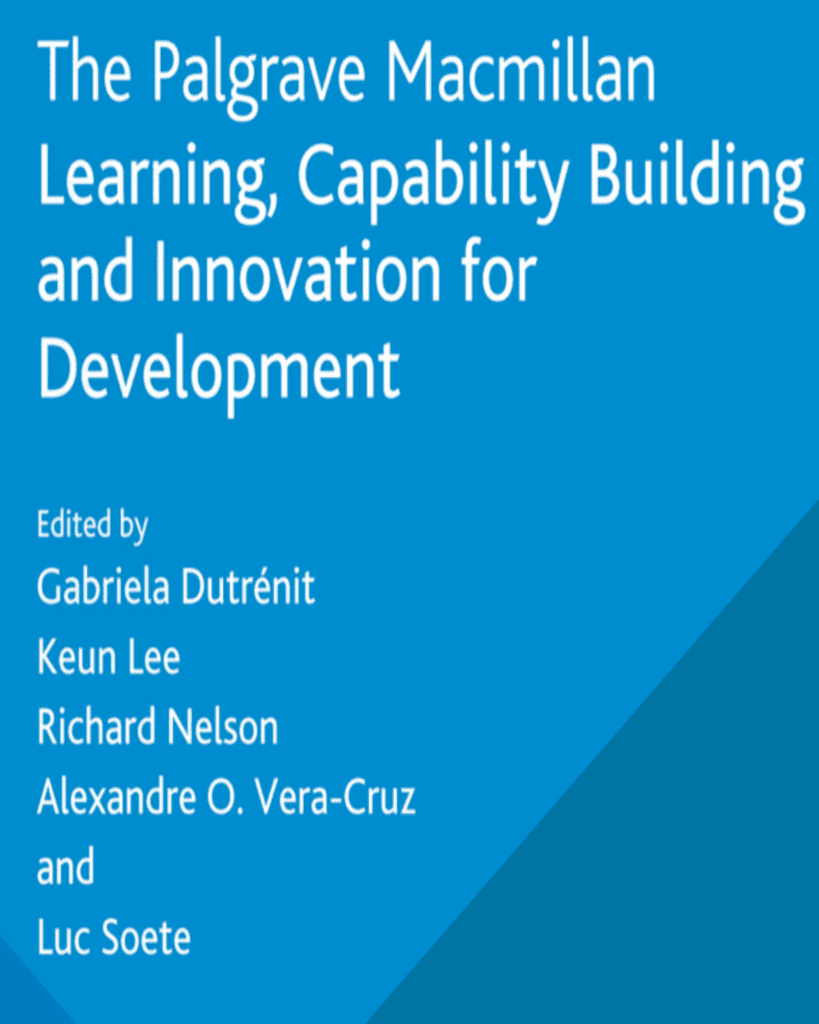
Learning, Capability Building and Innovation for Development brings together leading scholars in innovation studies and development economics to examine how countries can strengthen their technological capabilities and promote sustainable development through learning and innovation. Edited by Gabriela Dutrénit, Keun Lee, Richard R. Nelson, Luc Soete and Alexandre O. Vera-Cruz, the volume presents a rich collection of theoretical and empirical contributions that reflect the evolution of innovation studies in the context of developing economies.
At the heart of the book is the idea that development depends not only on access to technology, but also on the ability of individuals, firms and institutions to learn, adapt and generate new knowledge. Innovation is understood as a cumulative and interactive process that involves collaboration among businesses, universities, governments and other organisations. This perspective highlights the importance of building domestic capabilities that enable countries to respond to technological change and create their own development pathways.
The contributors examine how capability building occurs at multiple levels, from firms and industries to national innovation systems. Through case studies from Latin America, Asia and Africa, the book explores the diverse strategies that countries have adopted to strengthen technological learning, improve productivity and enhance competitiveness. These experiences demonstrate that successful innovation policies must be tailored to local contexts, recognising differences in institutional capacity, industrial structure and development priorities.
A recurring theme throughout the volume is the relationship between innovation and inclusive development. The chapters show that innovation is not an end in itself but a means of improving economic performance, creating employment opportunities and addressing social challenges. The book therefore emphasises the need for policies that support education, research, entrepreneurship and collaboration while fostering the diffusion of knowledge across sectors and regions.
The volume also addresses emerging issues such as globalisation, international knowledge networks and the growing importance of science, technology and innovation (STI) policies. It discusses how developing countries can benefit from participation in global markets while strengthening their own innovation capabilities and reducing technological dependence. Particular attention is given to the role of public institutions in creating environments that encourage experimentation, learning and long-term investment in knowledge.
Published in honour of the contributions of innovation scholars associated with the Globelics community, the book reflects the collaborative and interdisciplinary nature of the field. It demonstrates how the concepts of learning, capability building and innovation systems have expanded our understanding of economic development and continue to inform research and policy around the world.
Combining conceptual depth with practical relevance, Learning, Capability Building and Innovation for Development remains an essential reference for researchers, students and policymakers seeking to understand how innovation can contribute to inclusive, resilient and sustainable development in the Global South.