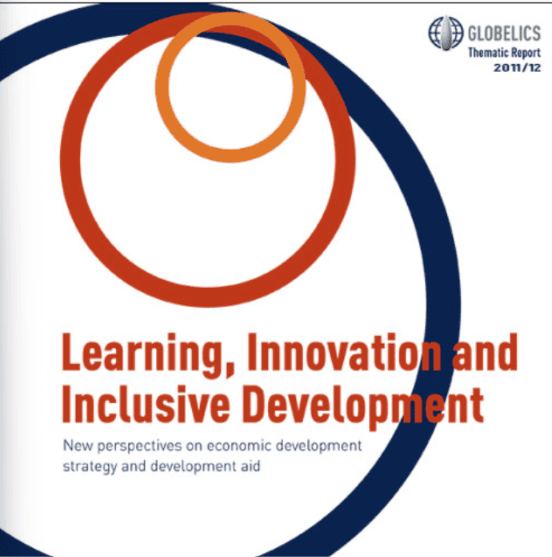
Learning, Innovation and Inclusive Development: New Perspectives on Economic Development Strategy and Development Aid is the first Globelics Thematic Report, edited by Björn Johnson and Allan Dahl Andersen. The report brings together contributions from leading innovation scholars to examine how learning, innovation, and capability building can promote more inclusive patterns of economic development. Rather than viewing economic growth as an end in itself, the report argues that development should expand people’s capabilities, participation, and opportunities while reducing social exclusion and inequality.
The report challenges conventional development strategies that prioritize macroeconomic stability or technology transfer without sufficient attention to local learning processes. Instead, it presents innovation as a systemic and interactive phenomenon that depends on the relationships among firms, governments, universities, civil society organizations, and communities. Inclusive innovation systems emerge when these actors collaborate to create and diffuse knowledge that benefits broad segments of society rather than only a small number of firms or individuals.
A central argument is that innovation should contribute directly to inclusive development. The editors emphasize that technological progress alone does not automatically reduce poverty or inequality. Effective innovation policies must strengthen local capabilities, improve access to education and knowledge, support small and medium-sized enterprises, encourage grassroots innovation, and create institutions that enable marginalized groups to participate in economic transformation. This perspective broadens traditional innovation policy by integrating economic, social, and institutional dimensions of development.
The report also examines the implications for international development cooperation. It argues that development aid should move beyond financing isolated projects and instead support long-term capability building, institutional learning, and national innovation systems. Donors, governments, universities, and local organizations should work together to strengthen local knowledge creation rather than simply transferring technologies developed elsewhere. This approach recognizes that sustainable development depends on countries’ ability to generate, adapt, and apply knowledge within their own institutional contexts.
Drawing on research presented across the Globelics community, the report illustrates how innovation can support inclusive growth in diverse settings throughout Africa, Asia, and Latin America. It highlights experiences involving agricultural innovation, industrial upgrading, education, public policy, and grassroots initiatives, demonstrating that development strategies are most effective when they combine technological change with institutional strengthening and social inclusion.
Overall, the report establishes inclusive innovation as a key concept within development studies and provides a comprehensive framework for understanding how learning and innovation systems can contribute to equitable and sustainable economic transformation. It remains one of the foundational publications linking innovation systems research with inclusive development and has significantly influenced the Globelics research agenda.