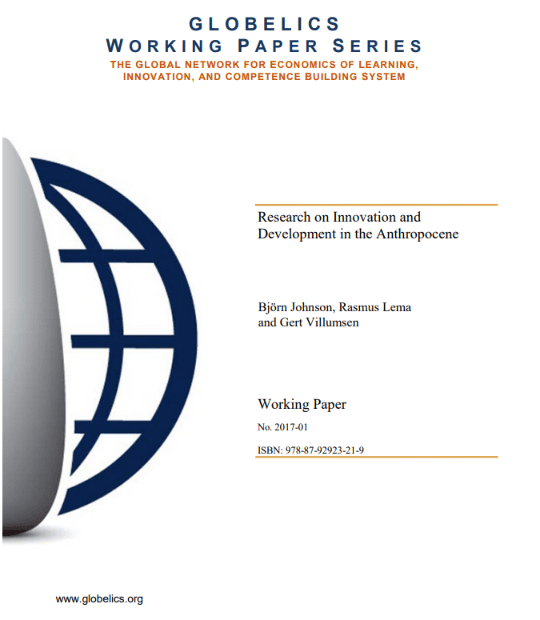
In Research on Innovation and Development in the Anthropocene, Björn Johnson, Rasmus Lema, and Gert Villumsen argue that innovation and development research must respond more directly to the unprecedented environmental and social challenges defining the Anthropocene. Published as Globelics Working Paper No. 2017-01, the paper proposes a new research agenda that integrates sustainability, innovation systems, and development studies, encouraging scholars to rethink the role of innovation in an era shaped by climate change, biodiversity loss, resource depletion, and growing inequality.
The authors explain that the Anthropocene describes a period in which human activity has become a dominant force shaping Earth’s ecological systems. While innovation has traditionally been associated with economic growth and competitiveness, they argue that these objectives are no longer sufficient. Innovation research must instead address the “grand challenges” facing humanity, including climate change, food security, water scarcity, environmental degradation, demographic pressures, and social inclusion. These interconnected challenges require innovation systems capable of supporting sustainable and equitable development rather than simply increasing productivity.
A central argument of the paper is that the widely used concept of sustainable development has become too broad and ambiguous to guide research and policy effectively. The authors propose complementing it with the concept of planetary boundaries, which identifies scientifically defined environmental limits within which humanity can safely operate. This perspective encourages innovation policies that explicitly consider ecological constraints while promoting learning, competence building, and technological capabilities. By placing these elements at the centre of sustainability research, innovation systems can become key instruments for achieving long-term environmental and social resilience.
The paper also critiques the innovation studies community for responding too slowly to sustainability challenges. Johnson, Lema, and Villumsen argue that existing research agendas have largely maintained their traditional focus on industrial competitiveness, national innovation systems, and technological change, without adequately incorporating environmental ethics or the transformative changes required by the Anthropocene. They call for stronger collaboration between innovation scholars, environmental scientists, policymakers, and development practitioners to create more integrated research capable of addressing complex global problems.
Looking ahead, the authors identify several priority areas for future research, including innovation for the United Nations Sustainable Development Goals, circular economy strategies, global value chains and sustainability, low-carbon transitions, and the relationship between inclusive innovation and environmental sustainability. These themes build upon the Globelics tradition of studying learning and capability building while expanding its research agenda to address the defining challenges of the twenty-first century.
The paper represents an important turning point in Globelics thinking. It argues that innovation research must move beyond supporting economic growth alone and instead contribute to maintaining planetary boundaries while fostering inclusive, resilient, and sustainable development. In doing so, it provides a compelling roadmap for the future of innovation studies in the Anthropocene.