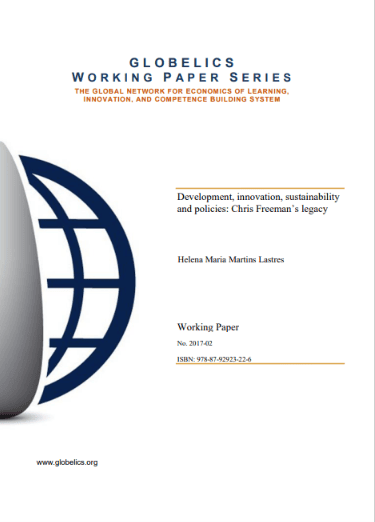
In Development, Innovation, Sustainability and Policies: Chris Freeman’s Legacy, Helena Maria Martins Lastres revisits the intellectual contributions of Christopher Freeman and examines their continued relevance for understanding contemporary development challenges. Prepared as Globelics Working Paper No. 2017-02 and based on the Freeman Lecture delivered at the 2016 Globelics Conference in Bandung, Indonesia, the paper reflects on how Freeman’s ideas continue to shape innovation research, development policy, and international academic collaboration.
Lastres argues that Freeman’s greatest contribution was his broad and contextualized understanding of development. Rather than treating innovation as an isolated technological phenomenon, Freeman emphasized that innovation is embedded within historical, institutional, political, and social contexts. Economic development therefore depends not only on technological progress but also on the interactions among governments, firms, universities, research organizations, and society. This systemic perspective became one of the foundations of innovation systems research and remains central to the Globelics research agenda.
A major theme of the paper is the importance of understanding technological change alongside broader structural transformations. Lastres discusses Freeman’s work on techno-economic paradigms, industrial change, financialization, globalization, and sustainability, arguing that these interconnected processes require equally integrated policy responses. She warns against fragmented innovation policies that focus exclusively on research and development or competitiveness while overlooking inequality, institutional diversity, environmental sustainability, and social inclusion. Instead, development strategies should strengthen learning capabilities, productive systems, and local innovation ecosystems that support long-term structural transformation.
The paper also highlights Freeman’s commitment to adapting innovation theory to different national and regional contexts. Lastres stresses that analytical frameworks and policy models should never be transferred uncritically from one country to another. Successful innovation policies must recognize historical trajectories, territorial diversity, institutional arrangements, and power relations. Drawing on the experience of the Brazilian RedeSist network and the Latin American Structuralist Approach, she demonstrates how Freeman’s ideas have inspired locally grounded research while enriching international debates on innovation and development.
Another important aspect of Freeman’s legacy is his role in building international research communities. Lastres identifies networks such as Globelics, RedeSist, and other regional Learning, Innovation and Competence Building Systems (LICS) initiatives as lasting achievements that continue to strengthen collaboration among scholars, policymakers, and development practitioners worldwide. These networks encourage comparative research, capacity building, and the exchange of ideas across regions, ensuring that innovation studies remain responsive to emerging global challenges.
Overall, the paper presents Christopher Freeman’s legacy as both intellectual and institutional. His systemic approach to innovation, commitment to development, and emphasis on learning, sustainability, and international cooperation continue to provide a powerful framework for understanding economic transformation in an increasingly complex and interconnected world. It stands as an important reference for researchers and policymakers seeking to design innovation policies that are inclusive, context-sensitive, and sustainable.