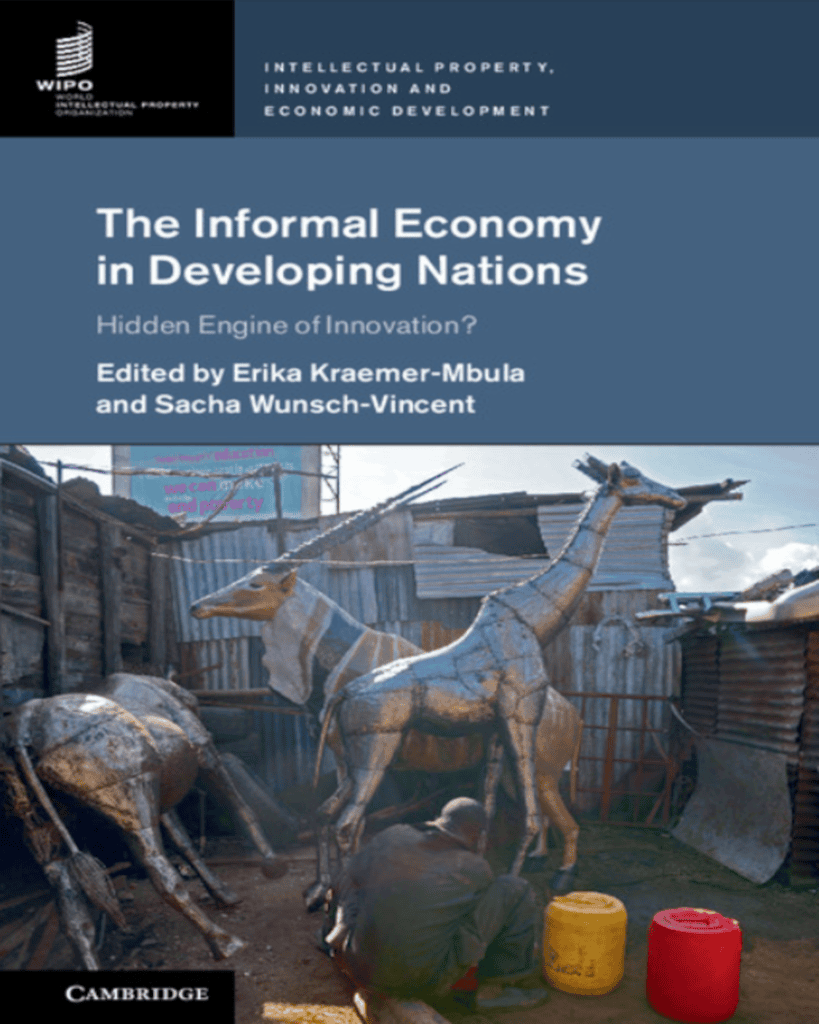
The Informal Economy in Developing Nations: Hidden Engine of Innovation? challenges conventional views of innovation by exploring the often-overlooked role of the informal economy in developing countries. Edited by Erika Kraemer-Mbula and Sacha Wunsch-Vincent, the book examines how informal enterprises create, adapt and diffuse knowledge despite operating outside formal regulatory and institutional frameworks.
The volume begins with the recognition that the informal economy accounts for a significant share of employment and economic activity in many low- and middle-income countries. Yet innovation research and policy have traditionally focused on formal firms, leaving the innovative activities of informal enterprises largely unexplored. The contributors argue that understanding innovation in these settings is essential for designing policies that support inclusive and sustainable development.
Rather than defining innovation solely in terms of research and development or high-technology industries, the book adopts a broader perspective that recognises learning, adaptation, problem-solving and incremental improvements as important forms of innovation. Informal enterprises frequently innovate by modifying products, improving production processes, developing new business practices and responding creatively to local needs and resource constraints. These activities, while often invisible in official statistics, play a vital role in supporting livelihoods, productivity and economic resilience.
Drawing on case studies from Africa, Asia and Latin America, the book analyses the diverse forms of innovation found within the informal economy. The chapters explore issues such as entrepreneurship, technological capability building, knowledge networks, intellectual property, skills development and interactions between formal and informal sectors. Together, they demonstrate that innovation is embedded in complex social, cultural and institutional contexts and cannot be understood solely through the experiences of large formal firms.
A central contribution of the volume is its emphasis on the relationship between informality and development. The contributors show that informal innovation should not be viewed simply as a temporary stage of economic development but as an important component of national innovation systems in many developing countries. Recognising these activities allows policymakers to design more inclusive science, technology and innovation (STI) policies that strengthen capabilities across the entire economy rather than focusing exclusively on formal institutions.
The book also addresses the policy implications of integrating informal innovators into broader innovation ecosystems. It highlights the importance of improving access to education, finance, infrastructure, markets and legal protection while fostering stronger linkages between informal enterprises, universities, research organisations and government agencies. Such policies can help unlock the innovative potential of informal actors and contribute to more inclusive economic transformation.
Combining conceptual innovation with rich empirical evidence, The Informal Economy in Developing Nations has become a landmark contribution to innovation and development studies. It broadens the understanding of innovation beyond conventional boundaries and provides valuable insights for researchers, policymakers and practitioners seeking to build more inclusive, dynamic and resilient innovation systems.


