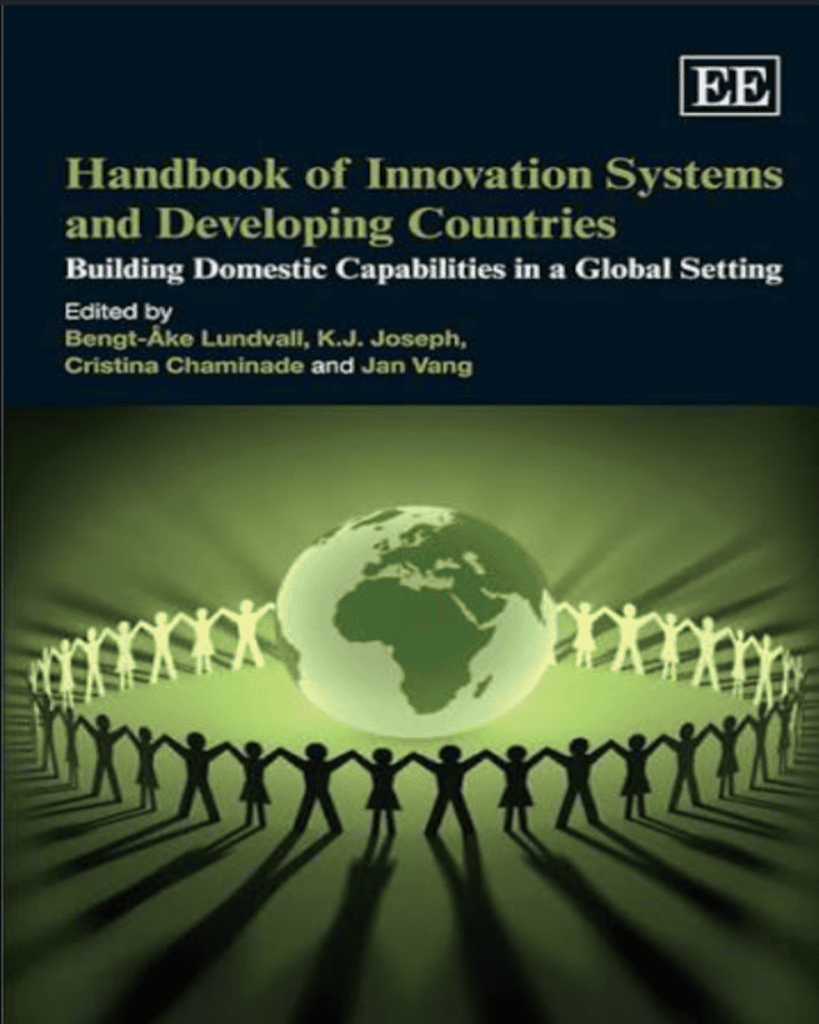
Handbook of Innovation Systems and Developing Countries examines how innovation can support economic and social development in low- and middle-income countries. Bringing together leading scholars in innovation studies and development economics, the volume extends the innovation systems approach beyond advanced economies and explores how countries with different institutional, technological and productive structures can strengthen their capacity to learn, innovate and compete in an increasingly interconnected world.
The book argues that innovation is fundamentally a process of learning and capability building. Rather than focusing exclusively on scientific research or technological breakthroughs, it highlights the importance of developing the institutional, organisational and human capacities that enable firms, universities, governments and other actors to generate, absorb and apply knowledge. Building these capabilities is presented as a key condition for achieving sustainable and inclusive development.
A central theme throughout the handbook is the interaction between globalisation and domestic capability formation. While international trade, foreign direct investment and participation in global value chains create new opportunities for technological learning, they do not automatically lead to innovation-led development. Countries must develop their own knowledge base, strengthen local institutions and design policies that encourage learning, collaboration and technological upgrading.
The volume combines conceptual discussions with empirical analyses from Asia, Africa and Latin America, illustrating the diversity of innovation systems across developing regions. The contributors examine topics such as industrial development, university–industry linkages, science and technology policy, knowledge-intensive services, agricultural innovation and the role of public institutions in supporting technological change. These case studies demonstrate that innovation policies must be adapted to local conditions rather than replicating models developed for advanced economies.
The handbook also emphasises that innovation should be understood as a broad and inclusive process involving technological, organisational and institutional change. Learning often takes place through production, collaboration, adaptation and the exchange of knowledge among multiple actors. This broader perspective is particularly relevant for developing countries, where incremental innovation, capability accumulation and institutional strengthening frequently play a greater role than frontier research.
By integrating theoretical advances with practical policy insights, the book offers valuable guidance for researchers, policymakers and development practitioners. It highlights the importance of coherent science, technology and innovation policies, investment in education and skills, and stronger connections between research organisations, firms and society.
Recognised as one of the key references in innovation and development studies, Handbook of Innovation Systems and Developing Countries has significantly influenced research on innovation systems in the Global South. Its emphasis on learning, capability building and context-specific policy design continues to inform debates on inclusive growth, structural transformation and sustainable development.